
What Your Body Is Trying to Tell You
(Understanding the Language of Sensation)
Before you could speak, you could feel.
Your first language wasn’t words — it was sensations.
That flutter in your chest or lump in your throat or knot in your stomach wasn’t random. It was your body communicating with you. They’re messages. Your body has always been trying to connect with you but you’ve just learned to tune it out.
In the Untangled Blueprint, we talk a lot about emotional awareness — not just what you’re thinking, but what you’re feeling. And not just emotionally, but physically. Because emotions live in the body. They show up as signals long before we have words for them.
Why This Matters
When we’re disconnected from our body, we miss the very cues that could guide us back to clarity, calm, and confidence.
We try to think our way out of a feeling, but the body doesn’t speak logic — it speaks energy.
Tightness, tension, heaviness, warmth, fluttering, pulsing — these are messages about what’s happening beneath the surface.
They’re your internal compass saying, “Pay attention. Something here needs your love, your breath, your truth.”
Understanding this language is a game changer because it helps you:
- Catch emotional dysregulation early, before you spiral
- Identify unmet needs in real time
- Reconnect with your intuition
- Choose self-support over self-judgment
When you can read your body like a map, you don’t get lost in your head.
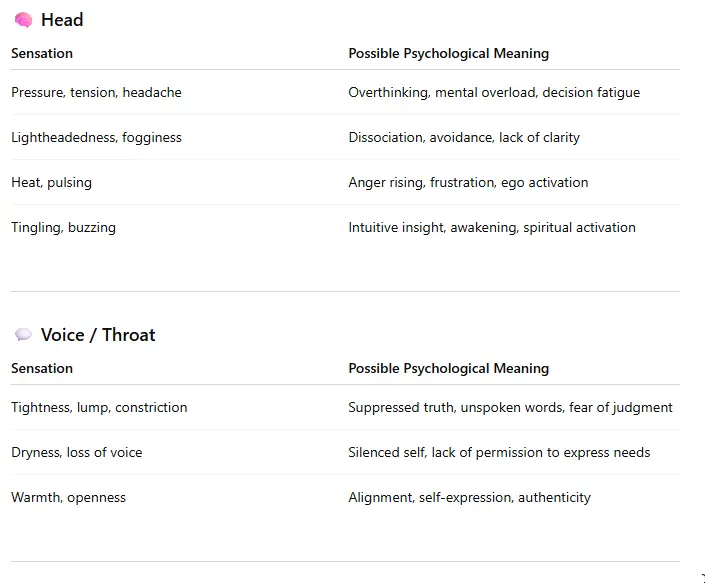
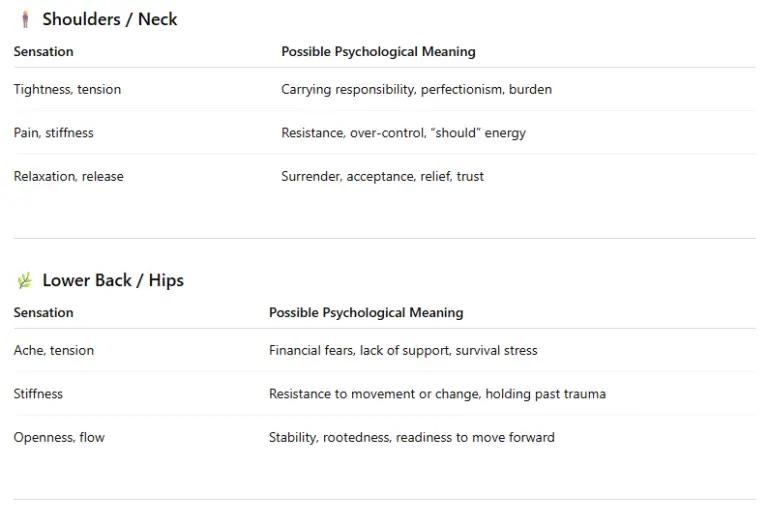
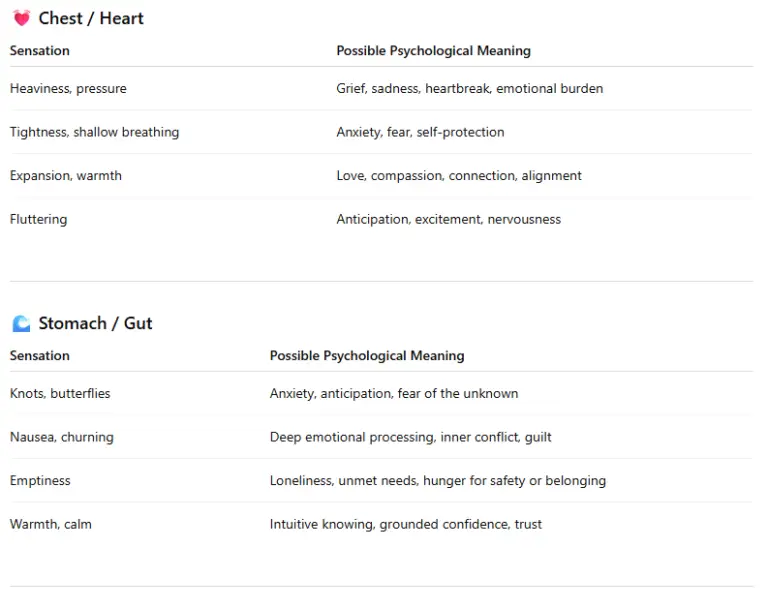
The Body’s Dictionary of Feeling: Translating the most common sensations and what they often mean beneath the surface.:
Body Sensation | What It Often Communicates | Possible Emotion / Need |
Head pressure or tightness | Too much mental load, looping thoughts | Overwhelm, anxiety, need to pause or simplify |
Chest heaviness | Emotional weight, holding grief or responsibility | Sadness, sorrow, compassion fatigue |
Shallow breathing or chest tightness | Fear of loss, feeling unsafe | Anxiety, vulnerability, need for reassurance |
Chest warmth or expansion | Emotional alignment, truth, connection | Love, gratitude, joy |
Stomach knots or nausea | Something feels off, conflict between head and heart | Fear, guilt, unease, need for boundaries |
Soft belly or ease | Inner peace, trust, safety | Groundedness, acceptance |
Lump in throat or constriction | Unspoken truth, withheld emotion | Suppression, shame, need for expression |
Shoulder or neck tension | Carrying too much, “should-ing” yourself | Pressure, perfectionism, need to release control |
Lower back ache or weakness | Feeling unsupported or insecure | Financial stress, fear of survival, need for grounding |
Butterflies in stomach | Energy moving, anticipation | Excitement, hope, nervous joy |
Tears rising | Emotional release trying to happen | Sadness, relief, cleansing, permission to feel |
Jaw clenching or teeth grinding | Holding back truth or anger | Resentment, frustration, need for safety to speak |
Tingling in hands or energy surge | Energy activation, nervous charge | Adrenaline, readiness, inspiration |
How to Use This Awareness1. Pause Before You Problem-Solve 2. Locate Yourself on the Emotional Ladder 3. Ask What You Need, Not What’s Wrong 4. Offer the Feeling a Friend, Not a Fixer | When to Revisit This Chart
|
Your body is not betraying you — it’s communicating with you. Every twinge, tightness, and tear is an invitation back to self-trust.
In Untangled, we say that awareness creates momentum — and when you can read your body’s language, you’ll never again be at the mercy of your emotions. You’ll know exactly what they’re saying, and more importantly, what they’re asking you to do next.
Now, it’s your turn to listen.